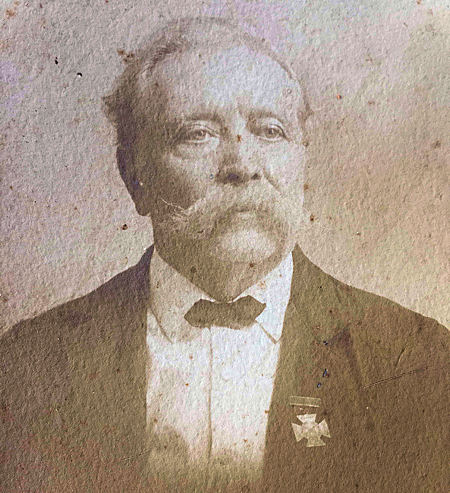
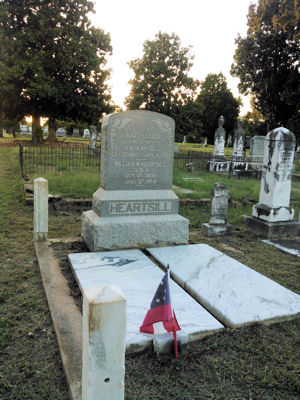
William Williston Heartsill
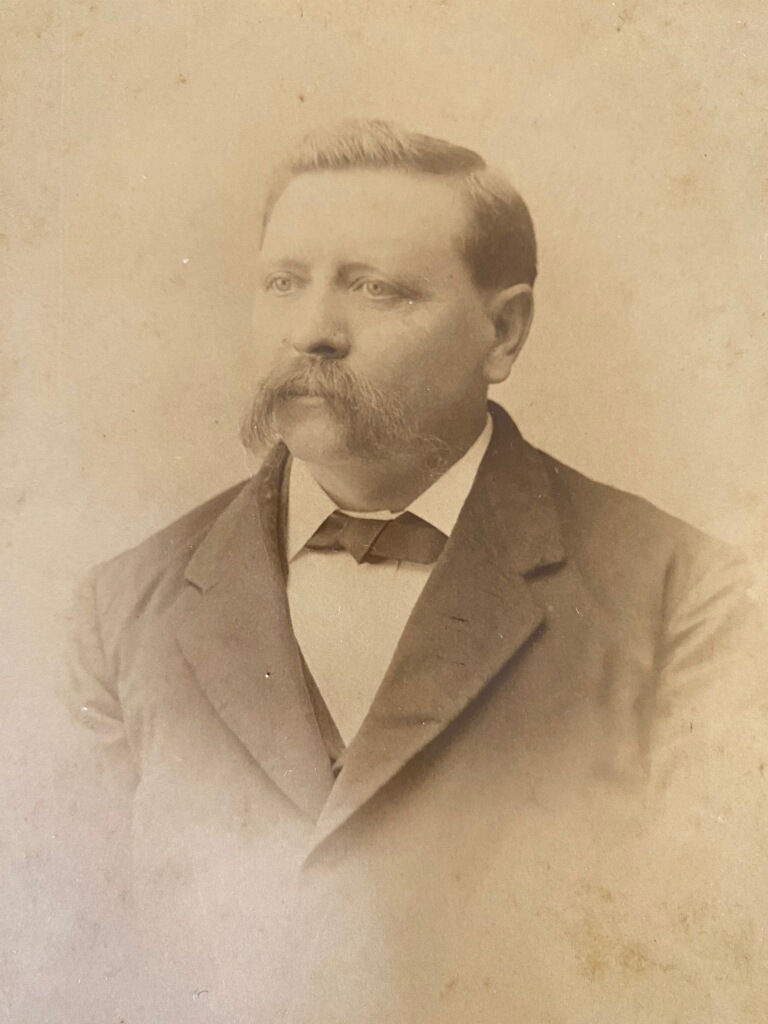
William Williston Heartsill was born in Louisville, Tennessee, a little town on the Holston River near Knoxville, on October 17, 1839. He went to Nashville in 1856 at the age of 17 to become a traveling salesman. He got the "Texas fever" in 1859 and moved to Marshall. In Marshall he became a clerk in the Bradford & Talley store where he worked until joining the W. P. Lane Rangers.
On February 2, 1861, the Texas Secession Convention voted 171 for and 6 against to leave the Union. Very quickly a statewide election was held on March 2, 1861, on the question of secession with the yes votes winning by almost 32,000 votes. The count was 46,129 for and 14,698 against. 18 Texas counties voted against the movement.
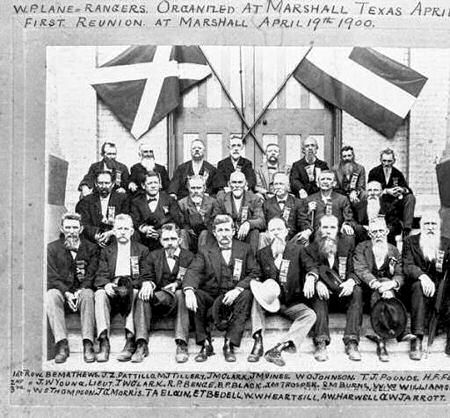
Harrison County Sheriff A.W. Crawford received permission from the Governor to raise a company of Rangers to serve for one year as a state militia. On April 7, 1861, the militia was raised in Harrison County with others coming in from other counties. W.W. Heartsill was among the ones joining. On April 19, 1861, 301 determined young men were sworn into the service of the State of Texas on the north side of the courthouse. They chose the name the W. P. Lane Rangers.
On April 20, 1861, the Mounted Rifle Company led by their elected Captain Samuel J. Richardson headed for Austin to draw equipment and to receive their assignment. They crossed the Sabine at Camden. (We still have a Shreve-Camden Rd.) The trip took 10 days. On May 4th they left for San Antonio to draw supplies. This took 4 days. They spent 2 weeks in San Antonio and were transferred and sworn into the Army of the CSA on May 23, 1861, and became Company F, 2nd Regiment, of the 1st Texas Mounted Rifles.
On June 6, 1861, they left for their first assignment as frontier guardians. They were sent to Ft. Wood 200 miles west of San Antonio to protect the frontier. The trip took 8 days. They protected the frontier for 10 months. On April 19, 1862, they re-enlisted in the CSA Army for a period of whatever time it would take to win the war. On April 24th they left for Marshall for a 20-day leave and reassignment. It took 19 days to get back to Marshall.
On June 20, 1862, the Rangers were ordered to Little Rock, Ark. But due to changes and misinformation they left on Nov. 3, 1862, for Little Rock. On Nov. 25th they arrived at Pine Bluff, Ark. They were ordered to Arkansas Post at Ft. Hindman and arrived on Nov. 29th. Shortly after arrival a serious problem with the mumps spread among the men including Heartsill.
Jan. 9th the Battle of Arkansas Post began with an estimated 70,000 total Union troops and Navy attacking the fort that had 4,000 CSA troops. After 7 attempts, on Jan. 11th an uncalled-for surrender appeared, surprising many including Heartsill who thought they were holding on against the overwhelming force. On Jan. 12th he was placed on the Steamer Sam Gatey for a 17-day hard, cold trip on the outside decks up the Mississippi to Alton, Ill. It was snowing and raining for most of the trip. They were placed in train cars and sent to prison camp at Camp Butler just east of Springfield, Ill., arriving on Jan. 31, 1863. To try to keep up his strength and to stay away from the sickness in the camp, he walked 16 miles a day in camp. By Feb. 27th, 125 prisoners from Ft. Hindman had died. On April 7, 1863, they were moved to the trains and shipped to City Point, Va. They arrived on April 14th and were released on April 15, 1863.
Heartsill received a furlough to go home to Tennessee to visit his family, and to report back to Tullahoma, Tenn., on May 26th to join his company to be assigned back to the Trans-Mississippi Army. When he returned, 80 of the company had already left for Shreveport and he and 10 others were assigned to a combined non-mounted brigade under Gen. Churchill in Gen. Bragg's Army of the Tennessee; they were called the Ark. Post Brigade. This was a great insult to the men to be unmounted. On June 1st they moved to southeast Tenn. and then to Ga., arriving on August 19th. Back and forth they moved like Gen. Bragg could not make up his mind, and all about this time they along with Capt. Nutt from Shreveport were sending requests to be sent back across the Mississippi. On Sept. 19th they were involved in the Battle of Chickamauga. After the battle they were back to moving back and forth to Lookout Mt. and preparing to battle again at Chattanooga. Captain L.M. Nutt was promised his men from west of the Mississippi would be released. On Nov. 3rd the remaining members of the W. P. Lane Rangers were for the 6th time denied a release to return to the West along with troops from Shreveport. This period was the only time Heartsill was disappointed in his service as he wanted to rejoin his brothers in the W. P. Lane Rangers. On Nov. 7th Heartsill and Sgt. Thomas Elgin and 2 others left for Texas, bound to get away from Gen. Bragg. On Dec. 20th they crossed the Red River on a pontoon bridge, arriving in Shreveport where they turned themselves in to the Provost Gen. They had traveled 736 miles on foot in 43 days. They were released to report to Capt. Richardson in Marshall and arrived in the "City of Sand" at 3 PM on Dec. 21st.
On Dec. 22, 1863, the Rangers were assigned to Camp Ford, Tyler, for service as prison guards. Heartsill & Elgin arrived on Feb. 17, 1864. On May 11, 1864, Heartsill was appointed Sgt. Major of the company at Camp Ford. On July 11th, after 201 days serving as prison guards, the Rangers were released to report back to Marshall. On July 16th they left Marshall for Shreveport and on July 21st the 90 men still in the company were sent south to Camp Polk and then to Alexandria and then northwest to Harrisonburg where the Tensas met the Mississippi, arriving on Aug. 12th. On Sept. 1st they were assigned to move to Pine Bluff, then they were told to go to Ft. Smith. On Dec. 7th they were sent back to Texas to head to Houston for its defense. They finally got as far south as Moscow, Texas, and were told to camp until notified. On March 13, 1865, the Rangers passed a resolution to return east to help in the fighting. On March 25th they were on the move to Houston, then ordered to Huntsville. On April 19, 1865, they celebrated 4 years as soldiers of the CSA. On April 23rd they got word of Lee's surrender and they were devastated. Apr. 27th moved to north of Walker County, May 7th to Anderson County. May 8th to Navasota where they heard rumors of Gen. Johnston's surrender. May 10th moved to camp on the Brazos, May 11th moved to Robertson County along the Brazos. May 13th heard that Johnston had surrendered and a rumor that Gen. Smith was going to surrender the Army of the Trans Miss. May 20th marched to camp on the Little Brazos (south of Hearne) where Col. Parsons told them that "They as an Army were disbanded." Heartsill was heartbroken. 4 years, one month, and 1 day in service to the W.P. Lane Rangers.
Heartsill went in at age 21 as a private and came out the Orderly Sgt. of the company. He was promoted to 2nd Sgt. on Nov. 2, 1863, and promoted to Ord. Sgt. in Jan. 1864, and went out on May 20, 1865.
Grand total on roll 206, mustered out 121, deserted 7, died 28, discharged 12, transferred out 25, missing 2, in Gen. Johnston's Army 11. In the 11 years after the war ended, 23 Rangers died.
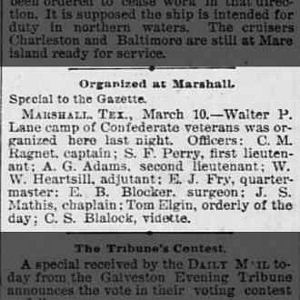
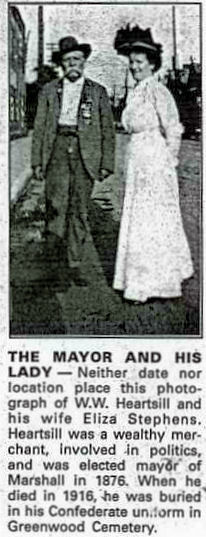
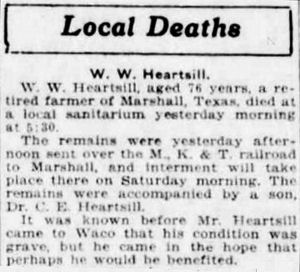
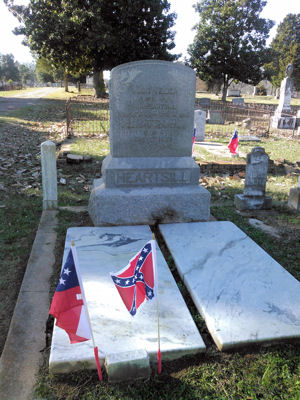
From Dec. 9, 1874, to July 1, 1876, he printed his diary of events one page at a time on his $10 "Octavo Novelty Press" at his business. He put together 100 copies that included 61 pictures. Of the 100 copies, only 13 are still around at the Library of Congress, University of Texas, Texas State Library, etc. Heartsill went on to be a successful businessman, Alderman, and later Mayor of Marshall. He served for 42 years as the Sec. of the Marshall Masonic Lodge #22 and served for years as a Steward and Trustee for 1st Methodist Church. He also was the Commander of the W.P. Lane Rangers UCV Camp. Heartsill died on July 27, 1916, in Waco, where his son Dr. Charles Heartsill had taken him for treatment of stomach problems. He was 76 years old.
Historical Pictures and Documents